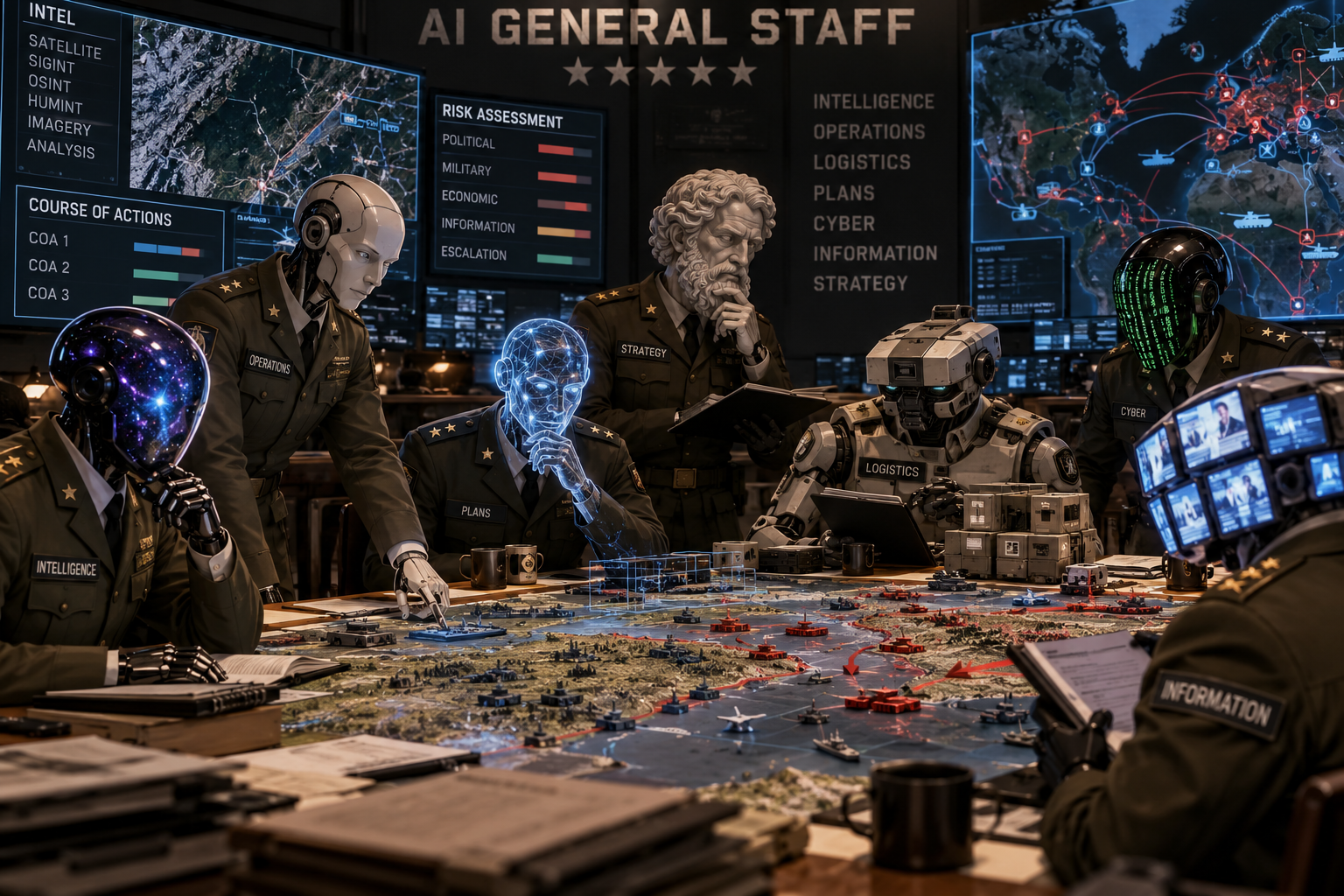
The key is that effective general staffs didn’t make a commander capable of continuously steering thousands of people. They built an organization that could act without continuous steering.
That required more than good orders. It required trained subordinates, shared working methods, reliable reporting, and a clear division between what headquarters decided and what local commanders could decide.
The mature nineteenth-century Prussian system—especially under Helmuth von Moltke—is a useful example. But it developed over decades, not through one organizational redesign.
1. Who made the high-level decisions?
Usually, the commander held authority; the staff made that authority usable.
Political leaders set the larger purpose of a war. Commanders translated that purpose into military objectives. Staff officers gathered information, developed plans, assessed feasibility, and prepared orders.
In practice, influential chiefs of staff could shape decisions enormously. Moltke, as chief of the Prussian General Staff, exercised substantial operational direction under the king. But a staff was not normally a committee of specialists voting on what the army should do.
The working relationship was roughly:
- Commander: What are we trying to accomplish? Which risks will we accept?
- Staff: What is happening? What options are feasible? What must each formation do?
- Subordinate commanders: How do we accomplish our assigned part under actual local conditions?
This distinction matters for agents. A planner, implementer, and reviewer shouldn’t each quietly invent a different definition of success.
2. How did an objective become actionable instructions?
Through successive levels of planning, with each level adding the detail appropriate to its responsibility.
Suppose the objective was to concentrate several dispersed formations against an enemy army. Headquarters couldn’t simply issue “concentrate.” Staff officers had to work out:
- Where concentration should occur.
- Which formations would participate.
- Which roads they would use.
- When they should depart and arrive.
- Where congestion or supply shortages might arise.
- How their movements depended on one another.
- What to do if the enemy disrupted the plan.
The resulting orders went to subordinate headquarters, whose staffs translated them into further instructions.
The decomposition followed the organization’s actual ability to execute—not just the logical structure of the goal. Assigning a corps a movement was meaningful because that corps already knew how to organize marches, feed troops, and manage its subordinate units.
There was also an important distinction between two kinds of work:
| Work |
Appropriate coordination |
| Mobilization, railway transport, movements through constrained routes |
Detailed schedules and procedures |
| Fighting an enemy whose actions could not be predicted |
Clear objectives, boundaries, and room for local judgment |
Prussian practice increasingly emphasized the second approach where circumstances demanded it, helping develop what later became known as mission command. It wasn’t “be autonomous” everywhere. Precision was used where dependencies required it; discretion where uncertainty required it.
3. What feedback mechanisms existed?
There were several, none resembling a perfect real-time dashboard:
- Routine reports: Locations, strength, supplies, readiness, and progress.
- Event-driven reports: Enemy contact, blocked routes, unexpected losses, or inability to execute an order.
- Reconnaissance: Scouts and patrols gathered information independently of the units carrying out the plan.
- Liaison officers: Officers traveled between headquarters to convey information and clarify intentions.
- Visits and inspections: Commanders and staff officers checked conditions directly.
- Telegraph: Increasingly useful in the nineteenth century, especially between fixed headquarters and across railway networks, but not a universal battlefield connection.
Staffs assembled reports into maps and assessments, compared actual developments with the plan, and prepared revised orders.
But reports were delayed, incomplete, and sometimes wrong. Headquarters might not know that an order had become impossible until hours later.
So local discretion wasn’t merely a leadership preference. It was a response to communication latency. A subordinate who waited for permission at every unexpected development could lose the opportunity—or the battle.
That discretion had limits. An effective subordinate needed to understand the larger purpose well enough to distinguish “change my method” from “abandon my mission.”
4. What made good staffs effective?
Much of their advantage was built before operations began.
Shared methods
Officers had common ways of reading maps, writing orders, estimating movements, and reporting conditions. An instruction didn’t need to explain the entire profession from scratch.
Practiced judgment
Education, exercises, war games, and staff rides gave officers practice making decisions under uncertainty. These weren’t guarantees of competence, but they reduced the need to teach basic reasoning during a campaign.
Feasibility checks
A plan had to survive questions about roads, time, supplies, and troop condition. Staff work connected ambition to physical constraints.
Clear responsibility
Staff officers assisted command; subordinate commanders remained responsible for execution. The exact arrangements varied, but effective systems avoided making every decision everybody’s business.
Selective intervention
Headquarters needed to intervene when the situation threatened the larger plan—not whenever a subordinate chose a different local method.
None of this made staffs infallible. They could institutionalize bad assumptions, produce brittle plans, and drown commanders in paperwork. A well-organized staff could execute a mistaken strategy very efficiently.
What this implies for your Jira problem
The uncomfortable implication is that a general staff doesn’t solve the problem of subordinates who cannot reliably execute their assignments.
Armies could delegate large missions because the units underneath had substantial, practiced capabilities. If your agent needs steering throughout a ticket, adding a planning agent and a supervising agent may just move your steering burden into another layer.
I’d diagnose each intervention you make:
- Missing intent: It didn’t understand the desired outcome.
- Missing context: It lacked knowledge of the codebase or constraints.
- Execution failure: It understood the task but couldn’t carry it out.
- Coordination failure: Its work conflicted with another task.
- Verification failure: It couldn’t tell whether it had succeeded.
Staff-like mechanisms help especially with intent, context, and coordination. They don’t automatically cure execution or verification failures.
A useful agent assignment would therefore include:
Outcome: What must be true when finished?
Constraints: What must not change?
Authority: What may the agent decide without asking?
Evidence: What tests or observations demonstrate success?
Escalation: What conditions require stopping and reporting?
Then feedback should focus on evidence and exceptions, not a continuous stream of narration.
The historical lesson is less “put a general above the swarm” and more: build units that can execute bounded missions, give them a shared understanding of the objective, and reserve central coordination for dependencies they cannot resolve locally.